A City Square at Lunchtime: A Five-Detail Observation Walk
A city square observation walk reveals how entrances, edges, seats, shade and paths shape a lunch break, without turning the visit into a sightseeing checklist.
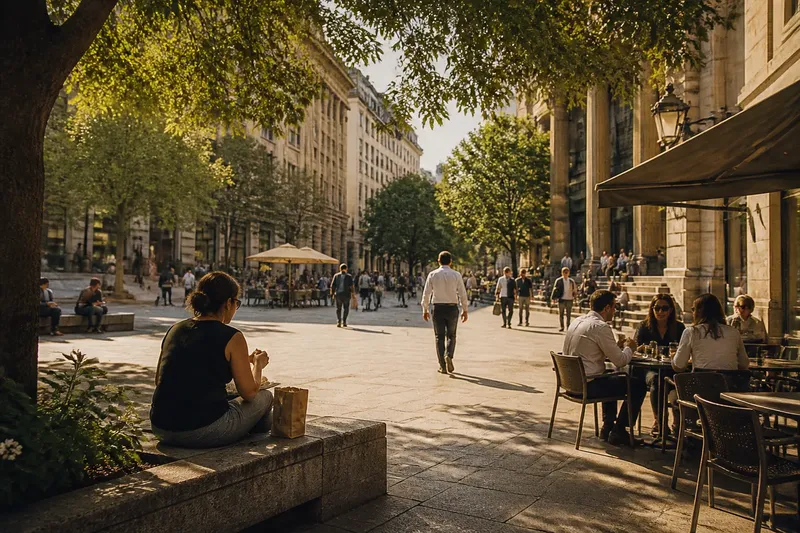
The common mistake on a city square observation walk is to look for a landmark and miss the ordinary arrangements that decide whether anyone can use the place comfortably. That costs you the square’s real story: how people arrive, pause, cross and share space during the busiest part of the day. Try a quiet circuit at lunchtime, using five details as prompts rather than boxes to tick.
You do not need to take notes or identify an architectural style. Stand where you can see the square as a whole, then move slowly enough to notice what people’s choices reveal. The aim is not to judge every design decision, but to connect visible features with everyday use.
Begin with the entrances
Find the points where the square meets its surrounding streets. An entrance might be a broad opening between buildings, a narrow gap beside a bus stop, a ramp from a higher pavement or simply a stretch of kerb where people naturally step into the space. Notice which approaches appear obvious and which seem to be discovered by following someone else.
Watch how arrivals behave. Do people enter directly and continue towards a destination, or slow down to check where they are? Are several approaches equally legible, or does one side seem to draw most of the foot traffic? A busy entrance may reflect nearby shops, a transit stop or a crossing as much as the square’s design. Look beyond the boundary before deciding what is shaping the movement.
Pay attention to the transition from street to square. A change in paving, a line of trees or a low wall can mark the threshold without closing it. A kerb, bollard or level change may influence who can enter comfortably. You are not conducting an access audit; simply notice whether the route seems continuous for someone pushing a pram, carrying lunch or using a mobility aid.
Read the outer edges
Move your attention to the perimeter. Edges are often where the square meets its surrounding routines: café fronts, shop doors, building steps, planting beds, busier pavements or quieter side streets. Ask what the boundary lets people do. A wide ledge may offer somewhere to sit, while a blank wall may leave passers-by with little reason to linger.
Notice whether the edges are active or exposed. Doors and windows can make a space feel watched and connected to nearby buildings; a traffic lane can make the same edge noisy or difficult to approach. Trees, railings and planted borders may soften a boundary, but they can also screen a corner or narrow a route. The useful question is not whether an edge looks attractive, but how it changes the choices available to someone walking or waiting there.
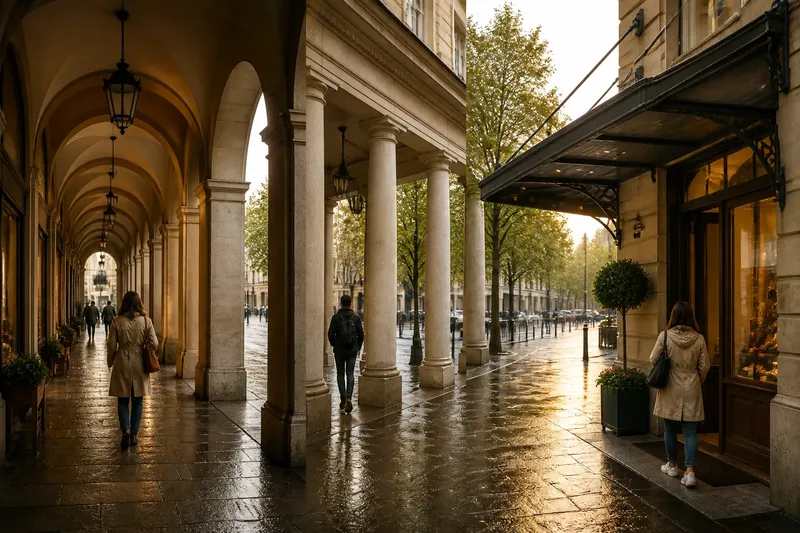
Look for small differences around the square rather than treating its perimeter as uniform. One side may have a sheltered arcade, another a sunny café terrace, and another a clear route to a public building. These variations help explain why people gather in one corner while another remains mainly a passage.
Notice who can sit
Seating tells you who the square seems prepared to accommodate. Look for benches, individual chairs, broad steps, low walls and places where people perch without formal furniture. Then notice how each arrangement works in practice: can someone sit alone without facing a crowd, talk with a companion, eat from a takeaway container or pause briefly without blocking the path?
Check the position as well as the presence of seats. A bench facing an open view offers a different kind of pause from one beside a café entrance. Seating under a tree may be popular because of shade, while a seat in the centre of a thoroughfare may feel too exposed for a longer stop. Observe whether people can choose between sociable and more separate spots.
Also notice who appears to have room to stay. Some seats may be occupied by lunching workers, while others suit people waiting for an appointment or watching children. A square can support these different uses without assigning a label to each person. Keep your observation about the setting: the seat’s height, orientation, shelter and relation to passing traffic.
Track shade and shelter
At lunchtime, shade often becomes a visible resource. Look for tree canopies, building shadows, awnings and covered walkways, then see where people choose to sit or stand. The pattern changes with the weather and time of day, so treat what you see as a moment in the square’s daily rhythm rather than a permanent verdict.
Shade is not the only kind of comfort. A sheltered corner can offer relief from wind or light rain; an open patch may feel appealing when the weather is cool. Notice whether the available shelter is paired with seating, or whether people have to choose between a dry place and somewhere to rest. A roof can also create a useful threshold between indoor and outdoor activity.
Imagine you arrive with a sandwich on a bright, warm day. The nearest bench is in full sun, while a tree shades a low wall beside a clear walking route. You might choose the wall for a brief lunch, then move when the crowd thickens; the observable result is a pause that uses an edge without turning the path into a bottleneck. This invented situation is a way to think about the choices the square affords, not a report of an actual visit.
Follow the paths
Now watch how people cross the open area. Some follow paved lines or planted borders; others take a direct route between entrances. A path can be marked by materials, but it can also emerge through repeated movement. Notice where walkers slow, where they weave around seated people and where several flows meet.
Do not assume that every line through the square is meant for walking. A broad paved strip might serve deliveries at certain times, while a clear central area can host informal play or events. Look for signs of competing uses: a lunch queue spilling onto a route, a cyclist cutting through, or a group occupying the shade beside a building entrance. The point is to see how people negotiate the space, not to declare one use correct.
Watch what happens at crossings between routes. Do people make eye contact and adjust their pace, or does a fixed obstacle force everyone into the same narrow passage? A planter may guide movement while also providing a place to sit; a bollard may separate vehicles from pedestrians but interrupt a smooth walking line. Consider the combined effect of the elements rather than reading each as an isolated object.
What does the square invite?
Where should I stand first?
Choose a place near the edge where you can see several entrances without standing in a doorway or blocking anyone’s route. Give yourself a moment to notice the overall pattern before following one feature more closely.
How long should the walk take?
Keep it brief enough to remain attentive: a slow circuit and a few pauses are sufficient. If a feature catches your eye, stay with it rather than hurrying to cover every corner.
Should I take photographs?
You can, but a photograph may preserve a view while missing the movement that explains it. If you take one, keep people’s privacy in mind and use it to record a spatial relationship, such as seating beside a route, rather than treating strangers as subjects.
What if the square is quiet?
Read what is there: open entrances, available seats, shaded patches and the routes that connect them. A quiet moment still shows the choices built into the layout, though the pattern may look different during another part of the day.
Connect the five details
The five observations become more useful when you link them. An entrance may feed directly into a shaded seating area; an active edge may draw people across a central path; a line of benches may leave a clear route between two busy streets. These relationships explain how the square works as a shared place, not merely as a collection of objects.
Try one question that ties the details together: where can someone enter, pause and leave without having to negotiate an awkward crossing? The answer may differ for a person walking through, someone meeting a friend and someone looking for a quiet place to eat. A public square rarely serves every need in the same spot, but its arrangement can make different uses compatible.
What is not worth the effort is trying to identify every paving material, count every seat or infer the whole history of the site from a single visit. Those tasks can distract from the simple evidence in front of you. If you are curious about a particular feature, note its location and check local information later rather than guessing.
On your next city square observation walk, keep the five details—entrances, edges, seating, shade and paths—in mind, but let the people using the space set the pace. A queue, a shaded pause or a stream of walkers can reveal how design meets routine. Leave with one clear relationship you noticed; that is often more useful than a long list of attractions.